
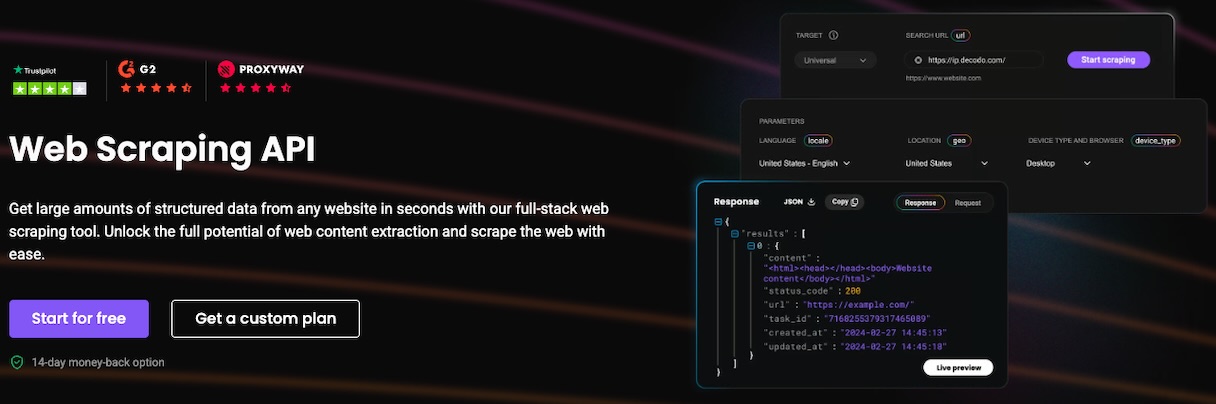
If you have been using Decodo (formerly known as Smartproxy) for proxy services, you will want to pay attention to this one. The company has just rolled out a completely redesigned Web Scraping API that fundamentally changes how you pay for scraping. Instead of locking you into fixed-tier plans where every request gets the same level of resources regardless of whether it needs them, the new API lets you control scraping complexity on a per-request basis.
This is a significant departure from how most scraping APIs are priced in the market today, and it is worth understanding what has changed and why it matters for your scraping workflows.
What Changed: From Fixed Plans to Modular, Per-Request Pricing
Under the old model, Decodo's scraping plans operated like most competitors: you picked a subscription tier that bundled together a set amount of requests with a fixed feature set. Need JavaScript rendering for one tricky target? You had to upgrade your entire plan. Want premium proxies for a single heavily-protected site? Same story — forced upgrades across the board.
The new model flips this on its head. Now, every single API request you make can be individually configured with exactly the level of power it needs. There are two main toggles you control per request:
Proxy Pool Selection — Choose between Standard proxies (optimized for simple, static pages with low-to-moderate security) or Premium proxies (built to handle advanced anti-bot protections, CAPTCHAs, and heavily-defended sites).
JavaScript Rendering — Enable or disable JS rendering per request. Static HTML pages that do not rely on client-side rendering can be scraped without it, keeping costs low. Dynamic sites that load content via JavaScript can have rendering turned on only when needed.
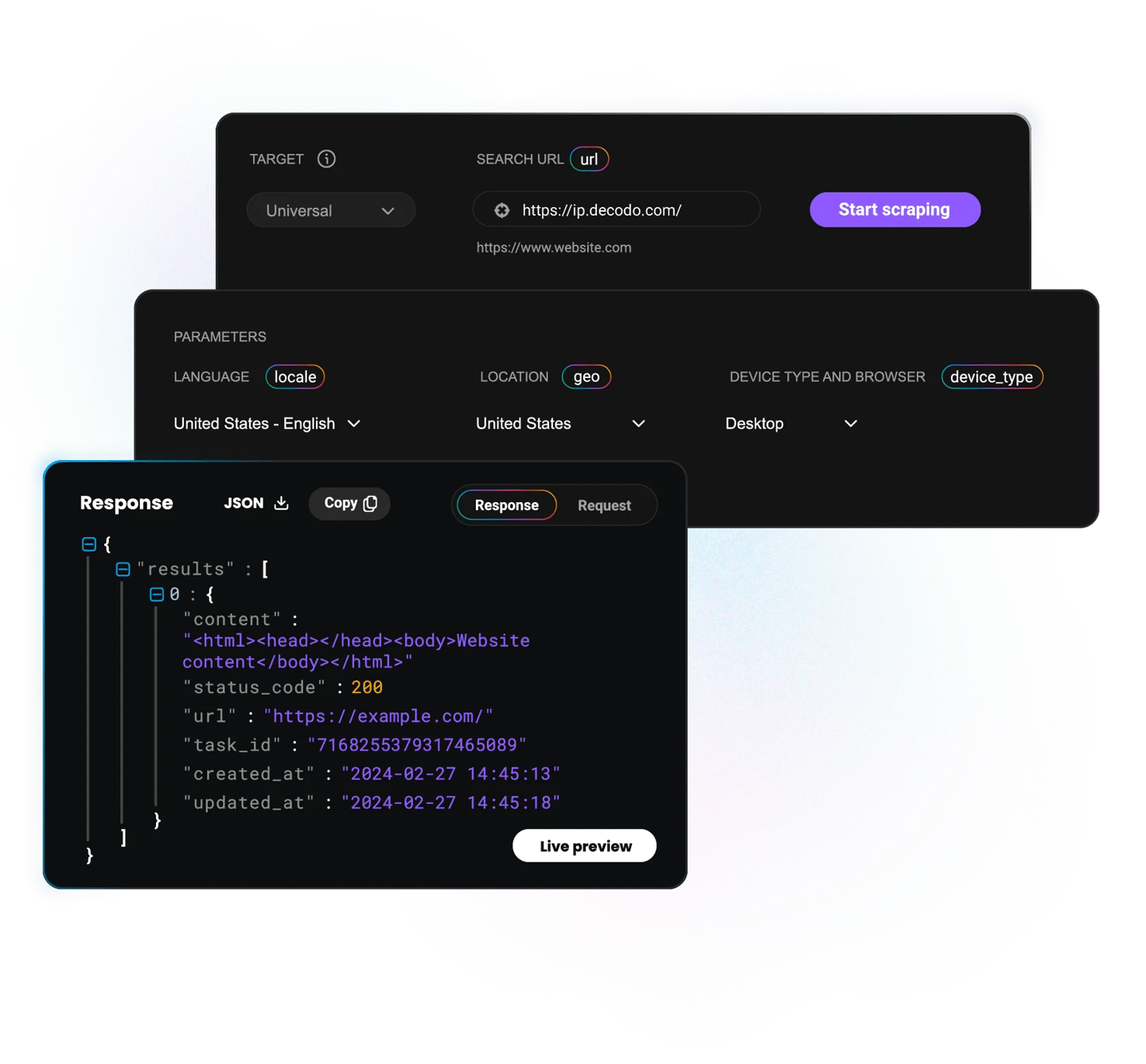
The result is four possible request types, each with its own cost per 1,000 successful requests: Standard proxies only (cheapest), Standard + JS rendering, Premium proxies only, and Premium + JS rendering (most expensive). Your monthly bill reflects exactly what resources each request actually consumed — nothing more.
Pricing Breakdown: What Does It Actually Cost?
Decodo offers several tiers, each with progressively better per-request rates. Here is how the pricing breaks down across all four request types:
| Plan | Monthly Price | Standard (per 1K) | Standard + JS (per 1K) | Premium (per 1K) | Premium + JS (per 1K) | Rate Limit |
|---|---|---|---|---|---|---|
| Free | $0 | $0.50 | $0.75 | $1.00 | $1.50 | 10 req/s |
| Starter | $19/mo | $0.50 | $0.75 | $1.00 | $1.50 | 10 req/s |
| Professional | $49/mo | $0.30 | $0.65 | $0.90 | $1.25 | 25 req/s |
| Business | $99/mo | $0.14 | $0.60 | $0.85 | $1.20 | 50 req/s |
| Enterprise | Custom | Custom | Custom | Custom | Custom | Up to 200 req/s |
The numbers tell an interesting story. If most of your scraping targets are simple static pages, you could be paying as little as $0.14 per 1,000 requests on the Business plan. That is extremely competitive. The cost only scales up when you actually need the heavy lifting — JS rendering or premium proxy pools for anti-bot-protected targets.
Compare this to a traditional fixed-plan model where you might pay a flat $1.00+ per 1,000 requests regardless of target complexity. For mixed workloads (which is what most real-world scraping pipelines look like), the savings can be substantial.
Why This Matters for Web Scrapers
Most scraping operations do not hit the same type of target over and over. A typical pipeline might look something like this: 60% simple static HTML pages (product listings, public directories, news articles), 25% pages that require JavaScript rendering (SPAs, lazy-loaded content, dynamically-rendered pricing), and 15% heavily-protected sites that need premium proxies and full browser emulation (major eCommerce platforms, social media, travel booking sites).
Under a traditional fixed-plan model, you end up paying the highest-tier price for all of those requests because the plan has to accommodate your hardest targets. Under Decodo's new model, 60% of your requests run at the cheapest rate, 25% at a mid-tier rate, and only 15% hit the top pricing. The overall cost difference for a mixed workload can be dramatic.
Key Features Beyond Pricing
The modular pricing model is the headline, but the underlying API is packed with features that make it genuinely useful for production scraping:
100+ Ready-Made Templates — Decodo provides pre-built, customizable scraper templates for popular targets including Google Search, Amazon, YouTube, Walmart, Bing, and many more. These templates handle target-specific anti-bot measures and parsing logic out of the box, so you do not have to reverse-engineer each site yourself.
Multiple Output Formats — Get your scraped data back as raw HTML, structured JSON, CSV, or even PNG screenshots. There is also an LLM-ready markdown output format, which is increasingly useful if you are feeding scraped data into AI pipelines.
Massive Proxy Infrastructure — Behind the API sits Decodo's proxy network of over 125 million IPs, including 115M+ ethically-sourced residential IPs, 10M+ mobile IPs across 700+ ASN carriers, and 500K+ datacenter IPs. Geographic targeting goes down to city and ZIP code level across 195+ locations.
200 Requests Per Second Throughput — On enterprise plans, the API can handle up to 200 concurrent requests per second. Even the free tier allows 10 req/s, which is enough for testing and small-scale projects.
99.99% Success Rate — Decodo claims a near-perfect success rate across their scraping operations, backed by automatic retry logic and intelligent proxy rotation.
Sync and Async Modes — Run requests in real-time for immediate results, or use asynchronous mode with callback integration for large batch jobs. Task scheduling with email notifications is also available for recurring scraping tasks.
Who Is This Best For?
The new modular pricing model shines brightest in a few specific scenarios:
Price monitoring and eCommerce tracking — If you are scraping product pages across dozens of retailers, some will be simple HTML while others (like Amazon or Walmart) require JS rendering and premium proxies. Paying per-complexity instead of per-plan means your simple targets do not subsidize your hard ones.
Market intelligence and research — Scraping a wide variety of sources (news, government data, company websites, social media) means constant variation in target difficulty. The modular model adapts naturally.
Agency and multi-client pipelines — If you run scraping infrastructure for multiple clients with different target profiles, you no longer need to maintain separate plans or over-provision for worst-case scenarios.
SEO and SERP monitoring — Google and Bing scraping is well-covered by Decodo's templates, and search results pages are typically straightforward enough to scrape without premium proxies, keeping costs low.
Getting Started: Free Tier Available
One of the nice touches is that Decodo offers a genuinely usable free tier: $0/month with enough credits for about 2,000 standard requests or 667 premium+JS requests. There is also an API Playground with 10 test requests per day, so you can evaluate the service before committing any money. All paid plans include a 14-day money-back guarantee.
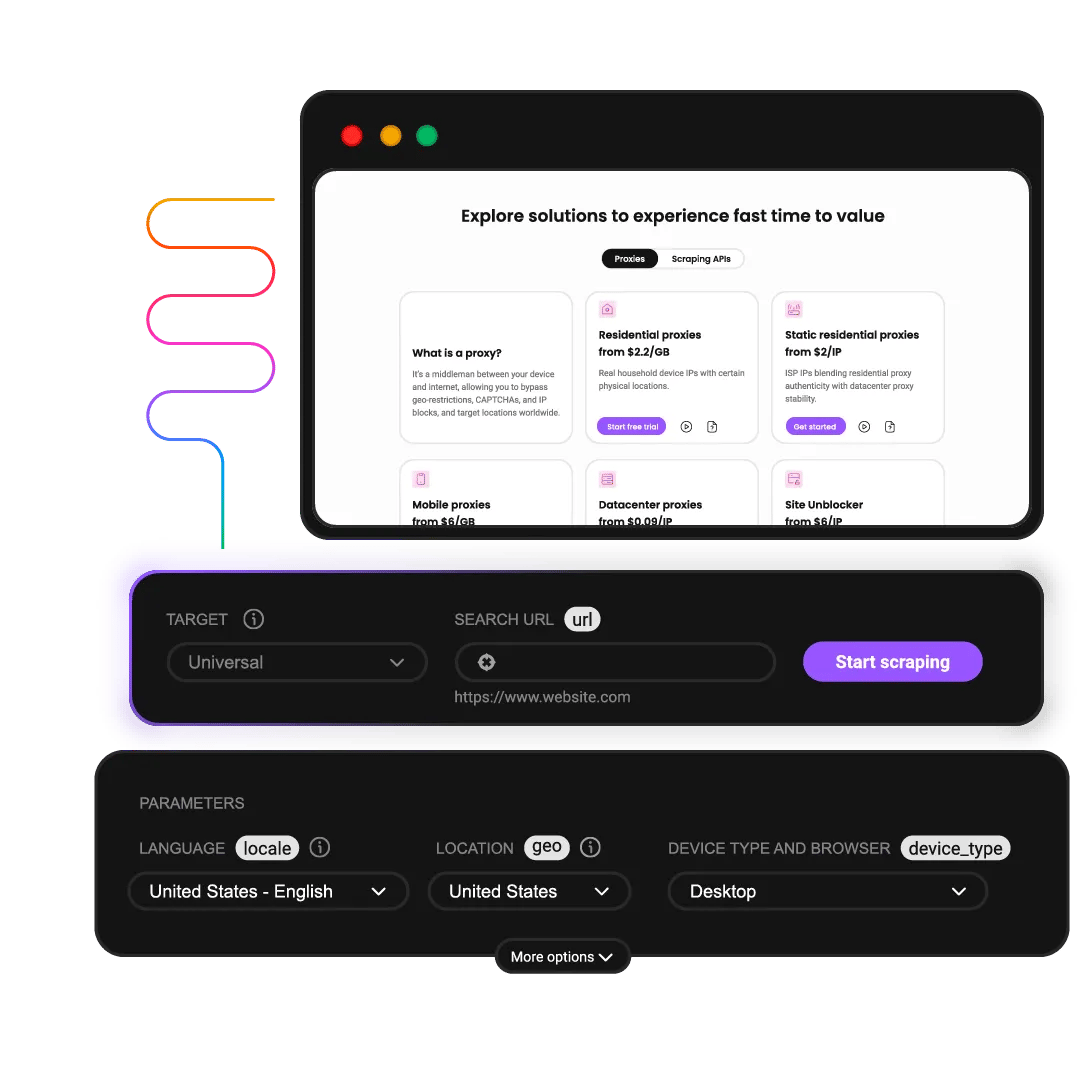
The API supports Python, PHP, and Node.js with code examples and Postman collections available in their documentation. Setup is straightforward — you get an API key, configure your request parameters (target URL, proxy type, JS rendering toggle, output format), and send requests through a single endpoint.
Our Take
The proxy and scraping API market has been moving toward more flexible pricing for a while now, but Decodo's implementation is one of the most granular we have seen. The per-request complexity toggle is not just a marketing angle — it genuinely changes the economics of running mixed scraping workloads.
If you are currently on a fixed-plan scraping service and your targets vary in difficulty (which, let's be honest, they almost certainly do), it is worth running the numbers on what your actual cost would be under Decodo's model. For pipelines that are heavy on simple HTML scraping with occasional need for JS rendering or premium proxies, the savings could be significant.
The 125M+ IP pool, 99.99% success rate, and 100+ ready-made templates are strong fundamentals. Combined with the new pricing model, Decodo's Scraping API is positioning itself as a serious contender for anyone running production scraping at scale in 2026.
You can try the new API for free at decodo.com — no credit card required for the free tier.